Showing posts with label review. Show all posts

Sunday, 5 January 2014

petzl zipka

From left to right, zipka (with aftermarket gaffa tape), zipka2, zipka+2
I've owned this little light- or at least a version of this light for about 7 years now. For that length of time, there has generally been one floating around my pack as a small, lightweight, emergency light source that I can wrap around pretty much anything.

The great thing about the Zipka is the sprung kevlar cord which, while not necessarily being comfortable for long periods of time, can be used in a variety of ways to attach the light to limbs or things around you to provide a decent light source.

Relative sizes- zipka +2 on top, and zipka below
Originally I used it as a light around my wrist as an adjunct to a head torch, mainly as a small, lower powered light to read a map by when the head torch was so bright that you got dazzled by shine-back from the map. To be honest, the original Zipka didn't have a massive amount of light, so reading and map-checking was about as far as it went. Using it to try and see where you were going was a little bit like using a mobile phone screen for a torch. Yes it produces light, and it serves quite well to ruin your night vision, but not actually any good for seeing where you are going.

The next version of the Zipka (the zipka 2) had 4 LEDs, which was a marked improvement. I didn't really
have a whole lot of experience of it myself, apart from looking at Lynnes with envious eyes as she actually used it as a torch for seeing where she was going, not JUST for map reading. Brilliant! Still the same AAA battery pack, still the same kevlar cord, but now a viable light source for wandering around in the dark, and certainly useful if you're on a hill, and everything else fails- much better than a slightly upgraded mobile phone screen. For a couple of years I was annoyed that I had given that to Lynne for Christmas... should have bought one for myself as well!

The more recent upgrade to the Zipka, I got mine last year, is the Zipka plus 2. (The green one in the photos). It has the same triple AAA battery pack, the weight hasn't gone up appreciably, the sprung kevlar strap is there, and the numerous LEDs on the front have been swapped for a single, larger, more powerful White LED and a smaller Red LED, which doubles as either a red light source and a battery power indicator.
Attached to something with a larks foot. Handy, Hands free.
THIS version of the Zipka is excellent as a single light source for walking, even running along trails and is my main go to light for dawn running. Slips on the wrist, I forget about it until I need it, and then it has enough
oomph to give light to the trail that I'm running along.
(for the geeks, thats 70 lumens- or 40m of lighting, apparently)
OK, so I wouldn't use it as a sole light for night fell running, its not that order of brightness, but for morning
patrols, it is excellent.

This, the most recent model has an option of bright, not so bright and flash, and then red, and red flash, all easily usable from the single push switch on the top.

Battery life, as ever with torches, is reported to be something incredible, 185 hours of "usable" light when on the lower lighting mode.
Which is insane.
I tend to find that I've used it for about 2 weeks worth of dawn running before needing to recharge the batteries. Yes, it still emits light, and yes it would be fine for walking, certainly more than enough for reading, but that's not what I want it for. Still. That's a decent enough amount of light.

The only minor issue with it is that occasionally when I'm out, the casing seems to have come ever-so-slightly loose - not so you'd notice - until you try and turn it on. Then there is no response from the light at all. It isn't the battery, and all it takes is a quick squeeze of the unit to make sure it is all fastened together properly, and off we go, the light goes on.
Also, yes you CAN use it as a head torch, and it stays there if you walk, but for running, you're far better off using it wrapped around your wrist, as it doesn't bounce around much there.
The way I tend to use one for pretty much everything. Hands free. 

A final point, the battery pack is now easy to get into- using a clip system as opposed to using a coin to get into it, and the light can be used with the petzl Core system- their own rechargable battery pack, but which has to be purchased separetly. No comment on that, never seen one, let alone used it.

Want a small, light, hands free torch to stick in a bag and forget about until you need to get off a hill? Need a small light to use for walks and runs on the trail? Need a small light to keep somewhere in the house in case of emergency? Need a small light to keep in the car for map reading?
THIS is the light.

Thursday, 14 November 2013

Vaude Hogan

Yeah, yeah, I know. Reviewing old kit... however, this one is worth it, and there is a current incarnation to get out and buy.

I've had this tent for a long time.
I remember using it for the first time in anger on my Silver D of E award, so that must have been about 1995 or 6 or so, so it's pretty old.

The main reason for buying it was because I was intrigued by the picture in the Cotswold catalogue. The tent appeared to have an exo-skeleton, and hung from it. It was a 2 man tent, weighted about 2.5kg so I convinced my sister that it would be a great tent and we should buy it.
This was very much like the original image that intrigued me. A tent with an Exo-skeleton? Cool
We did, and I've certainly had the lions share of use since then.

It has been re-proofed, re-seam sealed and re-proofed again, and still it carries on going. Until August in Switzerland, when I picked it up by the centre pole, and it snapped in 2 places on 2 seperate poles. A week before I was due to use it on my ML assessment.
On the upside, at least it went bang on a campsite and not somewhere on a mountain while I was being assessed.
So. Why am I raving about this tent? What makes it good?

It pitches in about 2 mins flat. I timed myself once a couple of years ago and could get it from in its bag to getting in a fully erect tent in 1:56. I don't think I could do that now, but it really doesn't take long.

The pole is an up in 1 type thing, it attaches to the base in 3 places, and then the bungee cord goes over and attaches back onto the tent, creating the 'exo-skeleton' look, pegs at the sides, back and one on the front of the porch, and its up- inner and outer at the same time.
2 guy ropes on either side can be used, but aren't really necessary unless it's crazy windy.
There is enough space for 1 to live very comfortably, and 2 to live relatively comfortably, if you are neat.

I've used it for trekking, car camping and multiple day expeditions, it has seen me through storms where 3/4 of the other tents in the campsite have been blown away (hellloo Llanberis pass), its been used for incognito wild camping, and has had its share of frigid nights in the Peak district with frost on the inside of the inner....

I'm about 5'9 and of relatively slight build, but the guy I've shared this with most often is about 6'2 and built quite a bit larger than me. I wouldn't say its been massively roomy, but we managed to not completely destroy the tent by sleeping in it at the same time.

The Hogan doesn't seem to be around anymore, though the ultralight and Argon versions can still be found in various places.
The closest thing to the tent I originally bought is the Vaude Mark 2, which boasts a slightly bigger vestibule, tensioners which can actually be re-tensioned while INSIDE the tent (which is pretty cool), a wider section at
the "foot" end of the tent, which would have been the main improvement I would have suggested to the
Yup. Thats properly broke
original Hogan, it is 4 season, and weighs in at a pretty excellent 3kg.
Ok. not quite the 2.4 that I originally thought my Hogan was specced in at, but close enough to its actual 2.6kg to not really worry too much about it.

Would I buy another one?
If I was in the same place in 1995/6 then I would say yes, definitely, without a shadow of a doubt. Currently, if I wanted a tent that was to do exactly the same as the Hogan, the answer, again, would be definitely. The
only reason I am not going out and splashing the cash as I type this is because my list of needs has changed - in terms of the weight I am willing to carry, and in terms of the space I need.

As geekery goes, I am actually about to sit down and make a spreadsheet of all the tents that may or may not work, and then attempt to get hold of as many of them as I can to see which one best suits my needs... it may take a while, but we'll have to see how it works.

In the meantime, take it as read that the Vaude Hogan, now the Vaude Mark 2, is a fantastic bit of kit. If you need a decent, bombproof 4 season, 2 man tent that can be put up in a gale and lasts for a ridiculously long time, look no further. This is the one.


Oh- and just as a bit of an update, I sent the pole off to Vaude UK, and they replaced the 2 sections of snapped pole for £15 each. However, they ALSO said that there is a fair amount of corrosion on a few of the other sections, so just watch out when pitching it in the future... Well, its going to my sister next, so she might need to be careful....


Wednesday, 6 November 2013

SOL bivvy bag

Winter is coming. How do we know?
Its November. Pretty simple. 

Getting colder, getting grimmer out on the tops. 
If you're anything like me, you begrudge having to wear longs when running, even when the weather closes in. To be honest, I don't even like carrying a pair of waterproof trousers on most escapades in the hills, mainly because they are heavy and I KNOW that they aren't going to get used. 

However. What if it all goes pearshaped. What if it all goes belly up? 
Imagine being out there with a mate, or all alone, in proper rubbish weather in shorts and a waterproof top, a good few miles of dodgy terrain between where you are and anything remotely like "safety" and you go over on your ankle. 
Badly. 

Not an "ouch, that feels nasty", or an "I'll run it off". 
I'm talking about a full on snappingly horrendous dislocation. 
What then? 
I'm not worrying for the moment about getting off the hill. That is another issue. 
Lets assume for a moment that Mountain Rescue has been called, or that it will be called- at some point when you don't actually return home.
What I'm worrying about is surviving long enough to be rescued by said volunteers. If you're anything like me, you  tend to rely on output of body heat to keep warm, and having to stop soon chills you off.

Being out in the cold, the wet, the hypothermia inducing mingingness of the mountains and moors for an unspecified period of time (we might be talking hours and hours, probably in the dark) really isn't fun. Wearing just pertex, or eVent, or a Goretex top just isn't going to cut it in terms of keeping you non-hypothermic. 

So what to do? 
Old school heavy plastic survival bags were never particularly good. The main thing about them was that if you had ever attempted to stay overnight in one of them, you would do your damndest never to experience the misery again. So having one in your bag wasn't any more of a comfort than not having one. 

Space blankets were pretty good at keeping heat in, but tended to be very fragile, and if you ever sat on a hill trying to stop one being blown away, you'll know they are a nightmare when ripped. 

Blizzard bags were a fantastic addition to the family of survival bag-esque things. 
A double skinned, baffled bag with elastic round each panel to make it compress. Brilliant. But heavy. Especially for the weight, and space conscious fellrunner. 
It would fit in a big rucksack, but I find that if I have one of those, then I'd have a Bothy Bag instead. 

So the options used to go like this - 
  • Survival bag - too big, heavy, and actually nothing more than a plastic bag
  • Space Blanket - smaller, lighter and insulative, but pretty fragile, and not the best thing to have when its flapping around you in a gale (but better than nothing)
  • Blizzard bag - blimmin brilliant, but a but heavy and bulky for runners. 
No wonder we never really carried stuff like that. 
Enter the SOL bag. 
I've had one for a couple of years now. Think of it as a heavier duty space blanket, which is a bag, and can be re-stowed if you use it and don't want to buy another one. However, at about £12 each, they are a good buy. (It does depend on where you get one from)
It is ridiculously light and fits in a 2 litre bumbag with lots of space to spare for the normal goods and chattles that you take on a run. The SOL bag is a constant in any bag that I take with me on the hill, no matter the length of the run. A good insurance policy, should I need to protect myself from the elements in a worse case scenario. 

If you run, and you like to travel light in the hills, have a think about what might happen, worst case. Would you be ok? Would twelve quid and a few grams save you? 
If you're going to buy one item to enhance your kit this year, get one of these.  

Monday, 15 July 2013

Ultimate Direction signature Ultra packs

For a good few years I have been lusting after a Salomon S-Lab running vest, but have never had the money to burn or the pressing need to actually seek one out and try it on. (Especially as the only places I could ever see to buy one were online...)
This weekend I had the pleasure of being on the general support for the Ultra Tour de Peak District in the guise of a massage therapist, I got to see a load of guys using one.
It rides pretty damn high. 
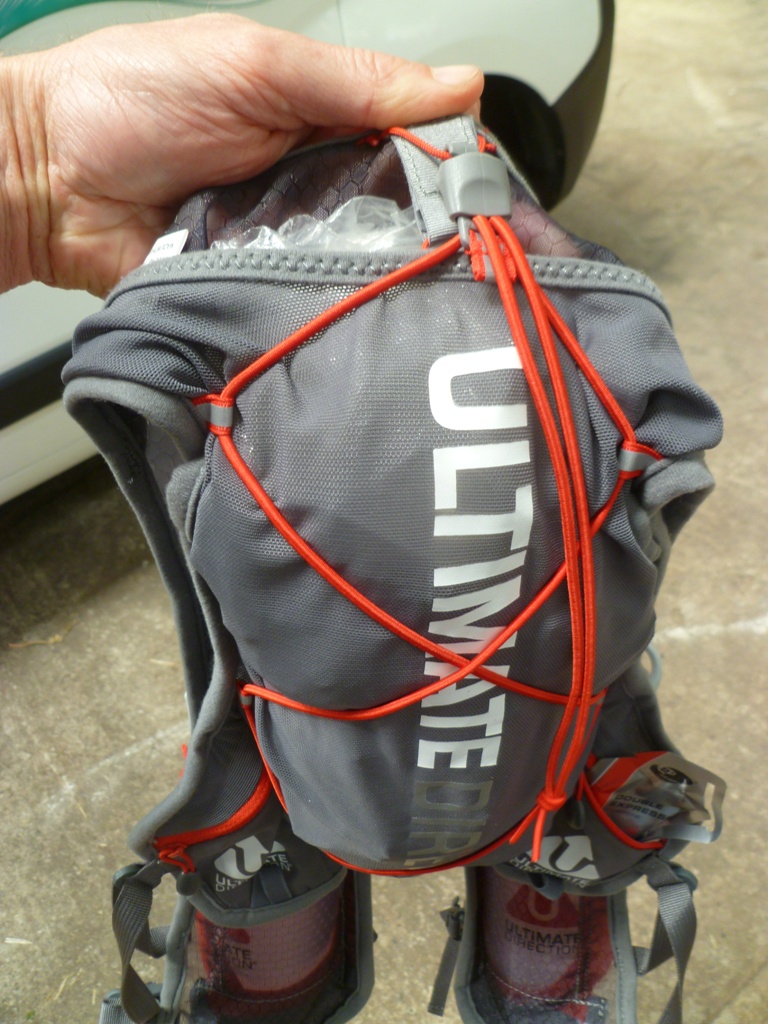
However, more interestingly, a good number of the competitors were using a seemingly lighter weight version of the same idea of pack, made by Ultimate Direction, and I managed get hold of 2 different versions to try on and generally play around with.

No I haven't actually worn one for running, sorry to say, but I don't quite have that clout...

Ultimate Direction are a company from the USA which has been in the ultra running market for quite some time, as such they have a fair amount of design experience. With this, the signature series of packs, they have roped in the design assistance of some pretty hefty names in the ultra world, including Scott Jurek and Anton Krupika.

First impressions of the packs is that they sit very high on the back, coming down to mid-back only, so it encompasses pretty much only the thoracic region, not extending down the the lumbar area, meaning that the motion of the hips when running should have no effect on the stability of the bag whatsoever.

The next thing to note is the ridiculous lightweightness of the materials used. The main material is a Hex-Mesh, which is pretty much see through, but has a reassuring non-rippiness to it, the pockets are very very stretchy, and seem to be made of some kind of power-stretch fabric, used in a lot of other lightweight kit, and the expandable parts of the main pocket is made of a thin white scrunchly material, somewhat akin to sail fabric called Cuban-fibre. It is light and tough. In fact, it seems tear resistant and nigh on indestructable. Apparently the fabric is the same grade of stuff used to make sails for the Americas yachts - it's non-woven, is not affected by UV rays, moisture or chemicals, and is 15 times stronger than steel. So they say.

There are 3 different signature models to choose from, The Jurek Ultra vest is 9.2 litres, and boasts attachments for ski poles or an ice axe, the mid-range model the Adventure Vest- designed by Pete Bakwin is 8.5 litres, and apparently has a specific pocket for a locator beacon (this is the one that I didn't have a chance to try on), and the smallest version, the minimalist Race Vest has an expandable back, which goes to about 4 litres or so.

Each of these vests share some generic detailing, with the twin bottle holders on the front, the gel pockets in the top front of the vest. zipped pockets on the "wings" and the elastic compression across the back.

The Ultra Vest
Ultra Vest - Back
Very briefly - this has more pockets than you can shake a stick at. It would take a good memory, or a whole lot of practice at packing, racing and re-packing this bag in exactly the same way to ensure that you don't forget what you have stowed in each pocket, else you'll spend half the race trying to remember where you put that special caffiene gel.
It is relatively easy to get to most of the pockets, on the outside of the bottle holders, underneath the bottle holders etc. but because the vest sits so high, the underarm zipped pockets do need a bit of flexibility to be used on the go.
Pockets under the Water bottles- a feature on the Ultra vest and the Race vest
The expandable back piece looks like it could comfortably hold everything I'd need for a fell race, up to and including the Trigger, and maybe even with a small waterbladder in there as well. I'd be happy on solo runs for a very long distance. Which is kind of the idea.
Gel pockets on the Water Bottle pockets- a great idea
Cuban Fabric. You can also see the compression hooks, and the tops of the 2 zipped pockets. 
Hex mesh. See through, hyper-lightweight. Somewhere to store a waterbladder if you need to. There are various routing options for the tube as well. 
Everything looks to be to hand, except the stuff that you'd want to take the vest off for anyway- waterproofs etc.

The Race vest
A very pared down version of the Ultra Vest. Less pockets, less weight. The basic design is the same with the double bottles on the front, and a small back pouch, but this time with no zips. The pockets on the sides of the drink holders have gone, but the ones under the bottle remain, which is a nice touch. The wing pockets under the armpits are even smaller on this model, making arm/shoulder flexibility an absolute must if you are going to access these while on the move. This is the only one of the 3 which has an adjustable strap under the arm as well as over the shoulder, so it is a bit more tighten-up-able.
The rear pockets are small, and pretty far back, but the vest is crazily low profile. You can also see the strap to tighten in around the side of the body. 
No zips. Just a lightweight closure to keep stuff in and compressed down. 
Again, rides high on the back, has gel pockets above and below the bottles. 
This, the lightest and most minimal of the lot, I can see being of use on long Trail Races in the Summer, or on the continent. Though to be honest, if I needed to, I'd only really use the one bottle on a race, and use the other bottle holder to carry a map, or something along those lines- but then I don't tend to drink crazy amounts of water when running anyway.
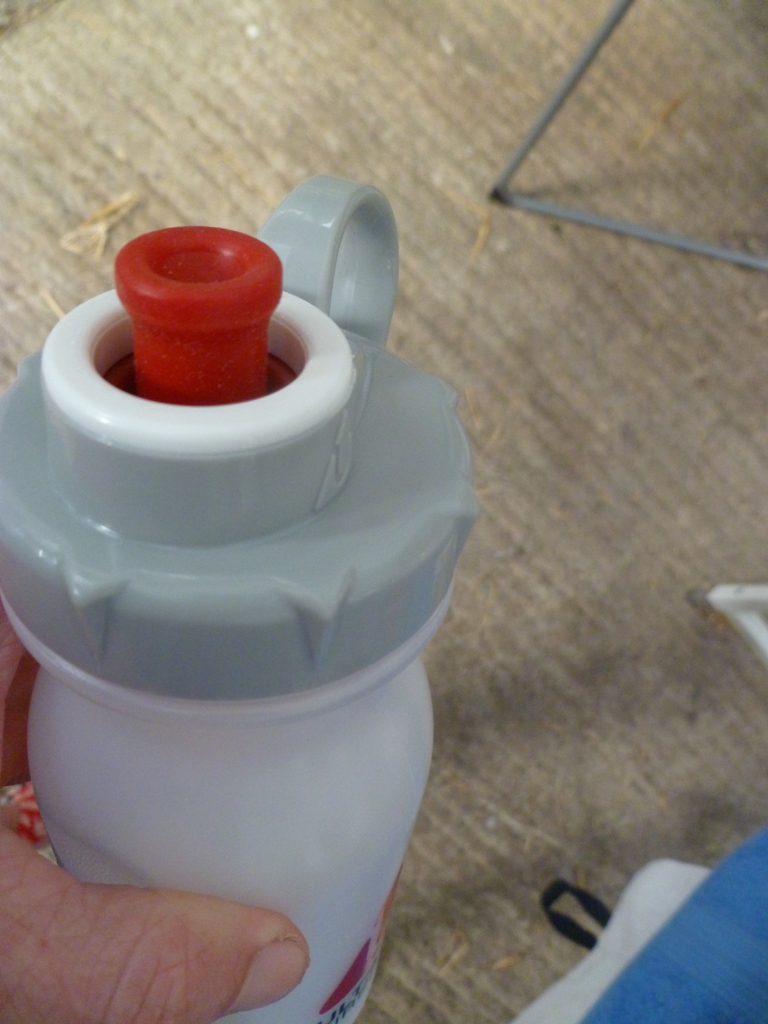
You may have noticed the bottles.... they have a camelbak type opening thing, this is the bottle in the closed position

And this is open. They seem pretty robust, but only time will tell what repeated pulling on them with your teeth will do. 
Both of these designs are a quantum shift away from the classic bumbag, with the constriction around the waist. Yes, they provide constriction around the upper thorax, but also distribute the weight across more area of the body. Would breathing be compromised on a huge or fast uphill? I'm not so sure, as the material is pretty stretchy. Yes, there may be some compromise, but maybe less than with a bumbag.

Overall then, yes, lightweight. Yes, very handy bits of kit. Yes, I can imagine running with one and feeling better about it than with a bumbag.
However, these things come at a cost. £75 for the race vest, £95 or thereabouts for the Ultra Vest and £125 for the Adventure vest.
For dedicated Ultrarunners, comparing these to the S-Lab vests, this is almost a no-brainer, so too is the weight, 212g for the Jurek Model, in comparison with the S-Lab 5 litre Hydration system at 313g, and £120 (but it does come with a water bladder) or the S-Lab 12 at £150 and 400g or so.

So it would seem there is a new voice on the Ultralight Ultra running market. I'm not sure that it will penetrate into the tightfisted world of the fellrunner, though I suspect we will be seeing more and more of these excellent packs around and about the place in the coming months.

Should I get a version to try on and run around the Peaks and the Lakes, I'll stick up a review to show how it goes.
One of the Vests about to be used on the 30 mile Intro Ultra at the UTPD this weekend just gone. 

Friday, 13 April 2012

Trigger Point Therapy roller - The Grid - Review


As you may or may not know, I am a fan of foamrollers - for self massage and myo-fascial release. We own a fair few, ranging from the soft to the ridiculously hard.
One of the main players out there on the running and triathlon scene is “Trigger Point Therapy" range which creates not only Foam Rollers, but also other things like a Massage Ball, and some other things called Quadballers and Footballers.

The Trigger Point Foam roller is called The Grid. It is made of a piece of tube (much like a 4inch drainpipe), and covered with a foam rubber like material, which has a number of ridges and bumps on which are meant to feel like a massage therapists fingers, elbows or the flat of the palm- depending on which surface you use.
Interesting.
It is retailing for about £45 or so in the UK (depending on where you buy it from)

Is it any better or any worse than any of the other rollers on the market?

I published my first thoughts on the roller a few months ago, but really wanted to give it a bit of time before giving any solid thoughts on it and how much I have actually used it.

Do the Nobbles and Bobbles work?

The Bobbles and Nobbles.
Once I got it out of the box, and begin to roll on it, it was evident it was a foam roller. 
Not much more, not much less. As advertised, it has a number of little bobbles and nobbles in it, which, as mentioned above are meant to mimic various types of strokes and parts of a massage therapists tools. To begin with I tried experimenting with the different surfaces, trying to find whether it made all that much of a difference or not.
The short answer is no, I don’t think it does.

When rolling down a hamstring or a quad, the length of the muscle is such that you use the entire roller. If you wish to precisely target a particular area of the muscle with a particular part of the pattern you can, but it just isn’t worth it.
Smaller muscles, again, the patterns, although they look pretty, I found no benefit in using the flat bit or the bobbly bit. So the nitty gritty bits- not all that fantastic.

What does it feel like in general?
It is actually quite a nice roller. Not too hard or soft. The hard internal tube covered with soft external foam rubber is good in design terms, because over a long period of use, even if the foam rubber does start getting softer, the roller with retain its rigidity. (A problem with other rollers which are uniformly one material throughout tend to get softer over time with a lot of use).
It is light and wieldy, and despite the reservations I had about its size- being a bit smaller than any other rollers I have had and used in the past, I was surprised and pleased that it was so good. 
Ok, so it is not quite as versatile as a 40 or 50cm long roller, but for the vast majority of things, it works just fine. The compact size, and the fact it is hollow make it pretty useful for travelling with as well. Another plus.

Over the past 3 months it has been the most used roller in the house.
Why is this?
Partially because I wanted to test it, but also, partially because it looks like a toy. It doesn’t have the forbidding quality of the black polystyrene roller of death, nor is it small like the white closed cell foam roller that we first bought. Its more like a Fischer Price toy, more like an Executive Desk Amusement Time Killer than something you use to keep soft tissue healthy. It is that almost psychological advantage of a well presented piece of kit over a tube of foam which makes you want to use it as you walk through a room.

Is it any better at what a foam roller is meant to do?
No. Not really. One foam roller is much the same as another. The hardness, length and diameter of the roller is pretty much dependent on which one you buy. The patterned effect on the Grid, to me, is pretty much a non-starter, so in terms of buying a roller, if you want something that is effective, you really really don’t have to spend anything like this kind of money on one. 

Back when I first got it, I was wondering if it occupied its own niche in terms of hardness/squidginess, or if it would double up as a partially soft, partially hard roller for all occasions. 
I do use it more, but mostly because I barely use the soft roller anymore, it's like I have grown out of it.  TP roller is a good replacement for it without being too hard. I'm looking for excuses to say that I would use it less, but to be honest, it is now the most used roller in the house. 

If you are a little on the roller-shy side, or just have one sitting in the corner which you occasionally look at and think- "yup- that’s a foam roller", maybe- just maybe, spending some more cash on an expensive one might guilt trip you into using it. Maybe the fact it looks kind of cool might make you use it more. If that is the only reason you buy it- then yes, it is worth the money. 
A foam roller that is used is much better than one sitting in the corner, no matter how much you may or may not have spent.

Conclusion
Although this is a very used piece of equipment, I suspect it may be simply because it is the newest, and therefore, least beaten up roller in the house. I don't know if it will get tired and rubbish in the long term, but looking at the construction, I suppose not.  I am wondering if it would be possible to make one with a piece of drainpipe, an old foam camping mat and some superglue, but have not yet started experimenting. 

All in all, its a good bit of kit, well made, well used, but if you are motivated to use a roller no matter what you spend and no matter what it looks like, to be honest, I still wouldn’t spend more than £20 on one.

Wednesday, 21 March 2012

Arc'teryx Atom SV- review

Me being snug. With some dodgy lens flare.
Fleeces are good at keeping you warm when its cold and there is no wind. However, as soon as a slight breeze begins, it tends to go straight through. Synthetic insulated jackets seem to be the answer to the problem of what to wear when its cold, windy and wet, when a down jacket would wet out too soon and a fleece would be too bulky and not provide any protection against the wind.

My down jacket is great, but standing on a hillside in the driving rain isn't the kindest thing I can do to it, and once wet, its as much use as a paper bag, and all my fleeces from years gone by, although still functional, are an additional weight which I could do without. Ideally I needed a synthetic insulated jacket before I moved up to the Peak District, and I'm very, very glad I bought one.

Synthetic "belay" jackets come in several flavours, with differing amounts of insulation for differing uses on the hill. They range from the super-lightweight Montane Fireball smock, for Mountain Marathons and as a layer that packs down to nothing, through to the ever popular workhorse, the Rab Generator Jacket (though the Atom SV is closer to the Generator Alpine) and the Mountain Equipment Fitzroy.

I decided on the Arc'teryx Atom SV for a number of reasons. Its main purpose was to be in my rucksack, ready to be deployed at a moments notice should we stop for any period of time, but it also needed to be warm enough to throw on over a shirt when going into town, and also, I managed to get it for less than I could get any of the other jackets- in my case an important point. 

Features
As this is a jacket for quick stops, fast warmth and convenience, it needed to be big enough to engulf any jacket I own, yet be streamlined enough to go under any other jacket I own. An interesting conundrum, but the cut of the jacket enables it to do that with ease.
The Atom is made with a silk like face fabric that Arc'teryx calls Luminara Nylon. It has a silky tactile feel and a fantastic DWR coating. It is 20 dernier ripstop, with good weather resistance, and apparently, is very breathable. The jacket itself is not classified as "waterproof" as it doesn't have taped seams, however, standing in the rain for a while is not an issue at all, as the water beads fantastically well, and sheds like a ducks back. (cliched I know, but its the only way to really describe it).

Lycra cuffs. Comfortable. Sleek. Convenient.
The inside fabric is, again, Luminara Nylon and it feels really very silky. Not something that you tend to say about fabrics on outdoor jackets. Wearing it into town just over a t-shirt is fine, and the lycra wrist cuffs are brilliant. I was never a fan of jackets without adjustable wrist cuffs, but recently there seem to be better ways of fastening around the wrist. The Atom is perhaps one of the most comfortable that I have come across.


Internal Pocket


It has 2 hand warmer pockets and an internal storage pocket that is pretty damn big, the hand warmer pockets have one side of them made with the Luminara Nylon and have the front side covered with fleece, so you get warmth and comfort at the same time. Mmmmm.

The tail of the Atom comes down a fair way and keeps your bum warm- quite an important point, you might agree, if you have ever been on a hill with a cold bum.
Also, you can roll the whole thing up into its own hood. Great to have a small package just on top of the sack to shake out and stick on at a moments notice. You can crush it down smaller, we've even managed to get it into a 1litre waterproof bag... but I've never had the need to when going on the hill.

The hood itself is easily big enough to accomodate a small helmet (we're talking petzl elios type thing), and it has a volume adjuster as well, so that if you aren't wearing a helmet, it doesn't blow about too much.
As I mentioned, the fabric is silky smooth, however, I'm not sure how bombproof it would be if you started to scrape it up and down granite slabs. It might be fine, but as soon as the going gets gnarly, I'd tend to take it off and stow it in the sack, or wear it as a mid layer with a more robust jacket over the top.

Fleecy cheek pad, and annoying internal drawcord
A lot of thought has gone into what can make this jacket comfortable. The baffle around the mouth and cheeks when the hood is done up is covered over with light fleece and there is a small lycra flap across the back of the neck to prevent drafts from wafting down your neck. Nice little touches that show a well thought out bit of clothing.

Insulation
The Atoms are insulated with Coreloft, Arc'teryx's version of primaloft. It is made with 100% polyester and is a lightweight and thermally efficient polyester staple fiber insulation.
Arcteryx says "Core Loft is constructed of a double strand of continuous polyester filaments. The finer yarns (1 denier) are "crimped" to help trap air molecules which in turn help trap body heat while the larger yarns (3.5 Denier) provide loft and resilience from compression. The fibres are siliconized to help add resistance to moisture and decrease drying time."
Yes, the jacket dries fast, I can attest to that, and the fabric appears to be breathable to a point, I certainly wouldn't go running in it, and its not really a noticable trait as you sit around getting warm on a hill.

To be totally honest, as far as I can tell if it is warmer than primaloft of the same weight, it is marginal. I'd love to give a comparison with drying times, but don't have a primaloft jacket to compare it to.


Issues
Yes, every jacket has its good points, but they also have their bad points.
The Atom has relatively few, but they are worth mentioning.
This happens EVERY time
The zip, designed to be easy opening- so that you can just pull the open part of the jacket and the zip undoes- works well. Too well. If you are sitting around, or even moving slightly, and the zip is not done all the way to the top it has a very annoying tendency to creep down until the jacket is gaping open. On a short walk through the fields the other day, despite the fact the zip was done up to the top, it kep creeping down. Every 3 or 4 minutes I had to re-zip it up to the top. Not a deal breaker, but a bit annoying.

The thing which is most annoying is the the toggles to cinch down the hood are on the inside of the jacket. Yes, it may make the outside of the jacket look sleek and snazzy, however, there is a minor issue in practice. Imagine you are sitting there in a rain/snow storm and it starts coming in through the hood. You want to close it up. You have to undo the jacket, fumble around inside the top for the drawcords (probably dispensing liberal amounts of snow/rain inside the jacket at the same time), pull them tight, and then do up the zip again. However, now, when you do the zip up, the cords don't sit down nicely inside the jacket, nope, they get caught up and stick out the top, and generally go up your nose. Really annoying.
Adjusting the hood. Thankfully not in a blizzard

Differences
Looking at the Atom SV vs the LT- The SV, as I mentioned has a hood, where as the lighter version- the LT, does not. The other major difference is that the SV has insulation all the way around the body. It is windproof throughout, and once zipped into it, with the hood up, it is like a cocoon. Fantastic, as long as you aren't about to suddenly break into serious amounts of exercise. You'll need to take it off soon enough, unless its ridiculously cold.
The LT on the other hand has underarm panels that are made of stretch fleece. not windproof, but they do let the jacket breathe a bit more, and may be a little more practical should you be using it to keep you warm as you participate in activity.


Overall
No, this isn't a jacket for hyperlightweight fiends, and people who want a slightly warmer layer to stick in a small sack for a Mountain Marathon. It's just a bit too heavy for that. As a belay jacket for a climber, yes, this would be a great jacket to throw on in a very cold place. Maybe a little too feature rich for someone on the higher end, if you are likely to be sitting on a belay for quite a long time as your partner hacks about above you, yes, this is a good jacket.
All packed up and ready to rock
I have used this in various situations of high demand, carrying things on and off hills, and then spending quite a while sitting and waiting in cold, wet, nasty conditions, before carrying other things back off hills, I've used it as a top layer and a mid layer, and I've used it for wandering down into town.

How I would improve it
Looking at the other options, I prefer aspects of other jackets, but I also prefer specific things about the Atom.
If I could have an insulated jacket with the cuffs and pockets of the Atom, with the hood pullcords on the outside, and a zip that didn't unfasten as you walked along/ sat still, it'd be pretty much perfect.

I can honestly say that despite its faults, this is pretty much the most used jacket for general hill walking, cragging and day to day life that I own. If I was going to pack a rucksack to take with me onto the hill right now, it'd be one of the first things on the pile.
The perfect jacket for hurrying up and waiting.

Monday, 20 February 2012

Salomon 3/4 exo tights

Men in Capris? Whatever next?

No, not Capris. These are 3/4 length running tights. Long enough to keep your knees warm, and short enough to ensure the bottom of your tights don't end up muddy and soggy as you plunge calf deep into some icy bog of horror. I really like the idea and the practicality of this kind of tight, and would have more of them if more different manufacturers made them (and if shops stocked them...)
Using exo tights in the snow
  
Salomon have made running gear for ages, and have had a go with compression- the Exo series. The basic premise is that there is a tight, which is elastic and provides some form of compression, however, to increase this, they have bonded on a hectagon shaped web thing across the outside of the material.
Its pretty cool to look at, and has some great design opportunities.
The question is, what does it claim to do, and what does it actually do?

Salomon say that the entire Exo range is designed with active compression in mind (as opposed to static compression- think post race and travel compression). They provide stability, a better alignment for the body as it goes through the gait cycle of running (particularly on rough ground or up or downhill, reduces cramp and soreness, and staves off injury.
This is the exact blurb
Run easier : Better alignment of your body to run easier on uneven trails downhill & uphill.
Run longer : Reduce cramping, muscle soreness, saving energy & preventing injuries. +5% of muscle performance.
Recover better : Improve recovery time. +11% of active revovery.

Thats quite a list.
There is also an interesting video on the Salomon website which shows a the quadriceps of a runner in slow motion, jangling all over the place as he foot plants, showing the inefficiencies and wasted energy of the muscles, and then with the exo-tights on, the muscles are kept in much better alignment, and don't waste time flopping all over the place after each and every footstep.

I have no idea how they came up with those numbers, but I'm sure there is some kind of scientific basis for it, though I haven't seem how the tests were done etc.

On the 15 trigs
I have a pair, and have used them extensively for running and adventure racing, so much so that I think they may well be coming to the end of their useful life as compression gear, and may well just have to be used as modesty covering for when I'm out running(!)

First impressions of the tights are that they look pretty swish- with the webbing on the outside of the material. It seems to be bonded pretty well, and with the various claims to keep you going stronger for longer, well, thats in the back of your mind as well. Something that looks like this and feels like this might actually work. Its not relying on the stretchy/squeeziness of the fabric on its own, but rather on the rubber webbing around it.

The hexagonal compression webbing
Put them on, and they immediately feel that bit tighter and solid around the legs than other compression gear I have worn. All around the quads. The compressive pattern doesn't go down as far as the knee, but just encompasses the main bulk of the quads and hamstrings, which is the best place to have it really. There is no gradual compressive force, or specific place in which it compresses- like CW-X, but just an overall general feeling of being squeezed.

Does it make any difference?
Unfortunately I am not in possession of fancy technical measuring stuff like what Salomon has access to, so I can't give specific numbers to talk about. Which is kind of annoying. However, I have quite a lot of experience of wearing them. I used to use them a lot for adventure racing- 8 hours+ of running and cycling, I don't know if it was psycological, or if they actually worked specifically well, but they kept me going right the way through.
I never really used them for shorter efforts- less than 2 hours or so, but more if I was out for a long day. I don't generally experience cramps when I'm running, if I do, its only really when I stop and take my shoes off. In that it stops me from getting cramp when running, I suspect it might be more the Exo-tights in conjunction with correct nutrition and hydration.
The most recent proper long long run I did in them was the Dark Peak 15 trigs. Could I have got around without them? Maybe. Would I have been in a lot more pain than I was? Almost definitely. Would I have been more tired by the end? Not sure if I could have been more tired, to be honest, but I suspect the answer is yes.

Do they work?
I think anything with an amount of compression will work to a point. It makes you (sometimes subconsciously) think about where your muscles are as you run. It gives you the proprioceptive knowledge of how they are working and what they are doing. There is of course the psycological boost- as you are wearing compression gear, it MUST be making a difference, so you MUST be able to keep going further. To be honest, sometimes the psycological edge may be a small one, but that edge is STILL an edge.

Issues
Delamination of Compression
I have had my pair for quite a while and they are beginning to destroy themselves. This isn't a recent thing by any means. The exo-skeleton bit of the tight is slowly becoming unbonded from the rest of the tight, meaning that as time goes on it becomes less and less effective as a compression garment. It started about a year to 18 months after I bought them it began to un-bond. At first it was only on the outside of the leg, but soon enough the whole of the bit in front of the quads was beginning to go.
Now, in places, I can get my entire hand behind the webbing.

The good thing about this (always look at the positives!) is that I can tell that where the webbing has become unbonded, the tights DO feel a lot less compressive, so there is indeed something to be said for the technology behind the webbing.
However, the bad thing about this is obviously this makes the tights a whole lot less efficient, less useful, and generally, an expensive garment that is meant to do something, but doesn't. I've been wearing them in this condition for quite a while. Wierdly enough I can actually feel where it is supporting on my leg and where it isn't, so as a test, I suppose its been quite good.

One other thing is the size of the drawstring around the waist. Its tiny, a bit like a garotte. I've never really liked it, and after a couple of runs have found that it really has been digging in a lot as I've done it up too tight. Maybe self-replacement would be the answer, just never got around to it. From looking at the website, they appear to have changed this for a thicker string now. A change for the better.

My version with glute compression
New version
The new glute non-compression
The pair I own is slightly different to the model which is on the market today. The Exo-skeleton covers pretty much the entire tight from the glutes, right the way down the Hamstrings and also all over the quads. The current model appears to have dispensed with the glute area (interesting, as they should be used extensively in running, uphill, and downhill...) and also there is an area across the front of the quads which doesn't have it either. So there is a break of compression directly over a muscle. Interesting. I suspect this may be a triumph of form over function as there is quite a nice Salomon logo there instead.  Coincidentally, the area where the webbing isn't there on the current model is the area in which mine started to de-laminate to begin with. Maybe that happened with a lot of the previous tights, and Salomon just decided that as it wasn't working there, maybe a bit of logo-age would be for the best. 

They still get a lot of use, perhaps only because they are the only pair of 3/4 tights that I own, and that alone makes them very useful. it would be interesting to get hold of a brand new pair and compare them against the old ones, see how much more support they give, especially now they have taken the compression away from the Glutes, and across the middle of the quads-  and whether or not they actually make me feel less fatigued, but I haven't seen them in any shops around me for quite a while.

There are, of course, also the calf socks and the tops (which I suppose work a bit like Asics Inner Muscle range), but I haven't had the opportunity to try them out. If the 3/4 tights are anything to go by, they are good to begin with, but I suspect you get diminishing returns on them as they get older and the compression bonds start to un-weld.

Would I buy them again? Yes, I would, but I still think they need more compression webbing on the glutes, and over the Quads. It seems that the old version is closer to what I would buy than the new.

Saturday, 11 February 2012

Ice Spikes on shoes

A footpath of icy death. Walk on it... or to the side?
As its still pretty ridiculously cold out at the moment, with quite a bit of freeze/thaw going on, this might be a bit pertinent to those of you who still want to go outside for amusement and recreation and still haven't quite worked out the best way of doing so when the ground is covered in sheet ice.

Low tech solution
This works for pavements that are covered in ice, black ice and general horribleness. Last year we lived in London and the area around where we lived was basically covered in a layer of about 3cms of glassy ice. There was no way you could get a grip on any of it without help.
The best way to deal with this is get a pair of old socks, and put them on outside of your shoes. Hey presto. Grip on ice. Works for walking, and for short distances. Your socks will also get trashed.


Walking on ice
Yaktrax were few and far between last year, no one was prepared for the ice and the waiting list for these in the shop was ridiculous. As soon as they came in, we were sold out. Craziness. They consist of a rubber skeleton which slips over the shoe, and has wire coils wrapped around the skeleton to enable the shoe to grip.
Yaktrax tread pattern
Great for walking, very good for walking over ice, but can occasionally slip on some of the more crazy slippy icy bits. Generally pretty damn good though. They are about £13, and for an extra fiver, you can get the "pro" version, which is basically exactly the same, but includes a velcro strap that goes over the top of the shoe to ensure that they stay on the shoe. Cheaper to use your own velcro strip, but there you go.

Issues with Yaktrax
The weak spot
Without the strap going over the top they do have a quite annoying tendency to ping off when you least expect it, and you end up spending all the time looking at your feet.
They are a nightmare to put on and take quite a while of scrabbling around on your knees.
If you run in them, or use them for prolonged periods of time, the rubber which you are treading on eventually wears through and they no longer retain shape.
However, they are great for occassional use, walking and generally getting about the place, especially in town. They can be used on the hill, but I'd prefer something a bit more gutsy.


Kahtoola Microspikes
Kahtoolas on water ice
A bit more expensive than Yaktrax (£45), but a lot more hard wearing. The rubber part goes over the top of the shoe and the metal part goes underneath. You don't have the worry that there is anything under the shoe that might give way because you stand on it funny, and the harness is very solid and secure- no concerns about them popping off your shoes mid stride at all. Also, because the rubber is a lot thicker and generally easier to handle, they are a lot easier to get on your shoes than the yaktrax.
Kahtoola tread pattern
The spikes protrude about 5mm, and are really quite chunky. I've used them on innumerable runs recently, pretty much from leaving the house to getting back in. Snow. Ice. Black ice. Nothing to worry about in any way shape or form. Ok, I'm not running at full pelt, but I don't tend to at night anyway. The great thing is, you don't need to worry about what you are running on, or what you are about to run on. The spikes seem to grip to anything, even the Pennine way, which, at the moment, is like an ice rink.
Spikes, and very secure attachments to the shoe
I can even run the last 500 metres on road back to my house without bothering to take them off. Its not totally comfortable, but I know that if I do happen to hit an icy patch on the road, I'm not going over.
These things just bite into anything
I really do love these things.
For racing, they may not be so practical, as you may need to take them off and put them back on again, however, for long days, and nights in the ice bound hills, I don't think you can get much better. Without these I would not have been out running the past few weeks. They are Brilliant. Actually. Brilliant.

Dobbed shoes
Oroc Studs
For racing, these are probably pretty damn good. Shoes with a grip, and with tungsten/carbide tipped studs that protrude as you run. Originally created (I think) by Icebug in sweden, a couple of companies have since used the same idea, most prominent in the UK being Inov8 with their Oroc range. I've never used a pair, and can't draw a direct comparison, but I have run with someone who was wearing a pair when I had my spikes on, and another friend just had a pair of normal fell shoes on. I was confident with every step, the guy with normal shoes on was all over the place, and the one with Orocs was relatively confident, but there were a few moments here and there where she was a bit less confident in her steps. Had I wanted to, I definitely could have gone faster, however, if we were racing, and I had to take the spikes off for a section, and then put them back on again, the time I made up in being more confident would have been eroded away by the fact she could just have run on through. So for racing, this kind of thing is probably better

Other things I've heard of but haven't managed to get hold of/use
Pogu spikes- much the same kind of thing as the Kahtoolas, but with an extra strap that goes over the top, a couple more spikes on the bottom, and a carry case. For the same price as the Kahtoolas, which isn't bad.

If you're out in the hills, or even just wandering around on the street- which is covered in ice, get something which stops you from falling over. If you're running, don't skimp, get something with some TEETH!